
 Whatsapp
Induction Billet Heaters: The Smart Choice for Forging Efficiency
In the ever-evolving world of metal forging, efficiency, precision, and environmental responsibility have become essential. One technology that continues to lead in all three areas is the induction billet heater.
This modern heating system offers unparalleled advantages in speed, energy consumption, and control, making it the preferred choice for manufacturers seeking to optimize their forging processes. This article explores what induction billet heaters are, how they work, and where they are widely used.
What is an Induction Billet Heater?
An induction billet heater is a type of industrial equipment used to heat metal billets — usually steel, aluminum, copper, or titanium — to the high temperatures required for forging.
Instead of using combustion or direct resistance, these systems rely on electromagnetic induction to heat metal quickly and uniformly.
The key advantage lies in its non-contact method: the heat is generated within the billet itself through eddy currents, resulting in faster, cleaner, and more efficient heating compared to traditional furnace-based methods.
Components of an Induction Billet Heater
At its core, an induction billet heating system consists of several integrated components designed for high-performance industrial use.
The induction coil is the centerpiece, generating a magnetic field that heats the billet. This is powered by a high-frequency power supply unit which converts standard electricity into the current needed for induction.
A cooling system protects components from overheating, typically through water circulation. The control panel allows operators to manage heating parameters, while the billet feeding system automates material handling for continuous production.
Together, these elements create a cohesive, high-efficiency system capable of meeting the demands of modern forging lines.
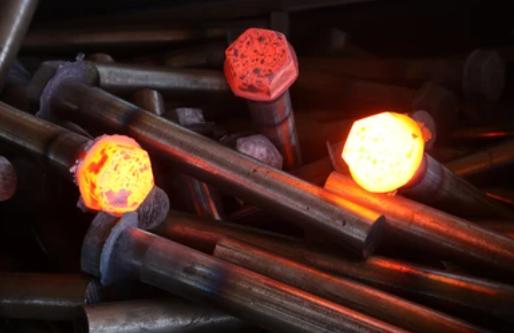
Working Principle of Induction Billet Heater
The science behind induction heating is both simple and powerful. When alternating current flows through the induction coil, it creates a fluctuating magnetic field.
As a metal billet passes through this field, electrical currents — known as eddy currents — are generated inside the metal. These currents face resistance, which in turn produces heat.
What sets induction apart is its localized, internal heating. There’s no need to rely on external heat sources or combustion, allowing for faster temperature ramp-up, reduced surface oxidation, and greater energy efficiency.
The billet heats evenly, reducing thermal gradients and enhancing the quality of the final forged product.
Induction Billet Heating System Features
Modern induction billet heaters focus on performance and flexibility. Features include fast startup, precise temperature control, and the ability to customize heating curves for different materials and billet sizes.
Automated features such as billet feeding, temperature monitoring, and system diagnostics further enhance production efficiency.
Many systems feature a modular design, making maintenance and future expansion easier. This adaptability makes these heaters suitable for both high-volume industrial production lines and small to medium-sized production shops.
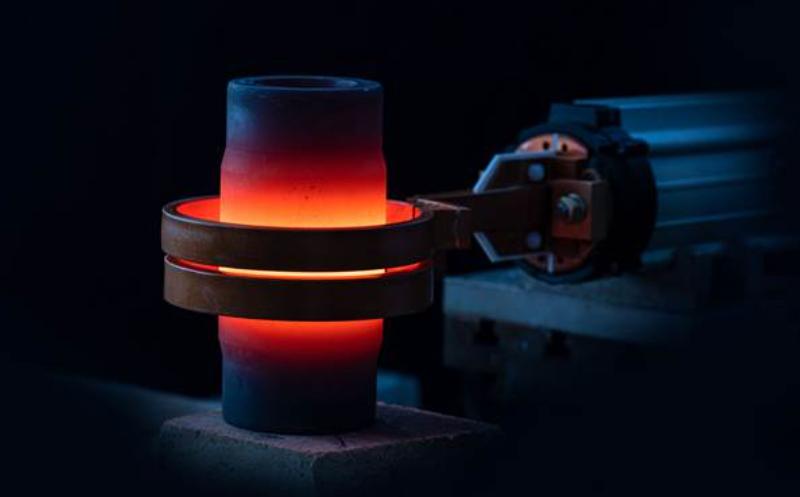
Benefits of Induction Billet Heater
The benefits of using an induction billet heater go well beyond energy savings. One of the most notable advantages is improved product consistency.
Because the billet heats uniformly, the chances of temperature-related defects such as cracking or uneven deformation are significantly reduced.
These systems also contribute to lower operating costs. They are more energy-efficient than gas furnaces and produce minimal waste heat, translating into reduced utility bills and improved workplace safety.
In addition, the lack of combustion eliminates the need for flue gas treatment and reduces the plant’s overall carbon footprint.
Another often overlooked benefit is the cleaner working environment. With no open flames or direct contact heating, induction systems pose fewer safety risks and help maintain a safer, more comfortable forge shop.
How to Choose an Induction Billet Heater?
Selecting the right system involves several considerations. The size and shape of the billets, the type of material being heated, and the required output rate all play a role in determining the specifications of the heater.
For example, heating larger billets or high-conductivity metals like copper may require a system with higher power output or different coil design.
It’s also essential to consider the available infrastructure, such as power supply compatibility and floor space. Additionally, companies should evaluate the level of automation they require, especially if integrating the heater into an existing production line.
Working with a reputable supplier or system integrator is key to ensuring the system meets both current and future production needs.
Common Applications of Induction Billet Heater
Induction billet heaters are used across a wide range of industries due to their versatility and reliability. In the automotive sector, they play a crucial role in the production of crankshafts, connecting rods, and other precision-forged components.
The aerospace industry uses them to process high-performance alloys like titanium and nickel for critical structural parts.
In construction and infrastructure, induction heating is used for shaping reinforcing bars and structural steel. Meanwhile, oil and gas applications depend on this technology for forging durable valves, flanges, and pipeline fittings.
Their ability to be tailored to different production requirements makes them suitable for everything from high-volume manufacturing to niche, high-precision forging.
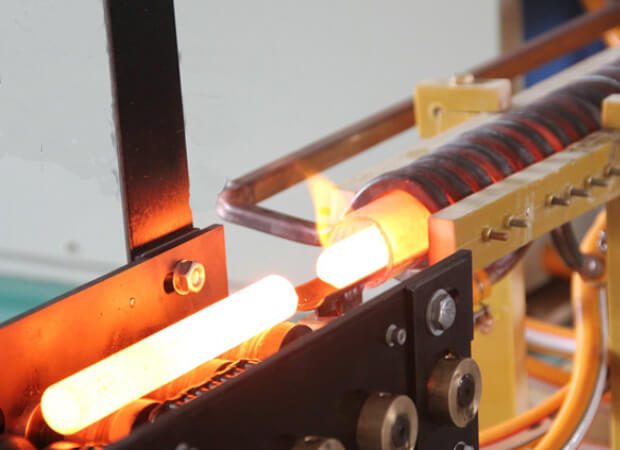
Induction Billet Heater Maintenance
Like any industrial system, proper maintenance is essential to keep an induction billet heater operating at peak efficiency. However, one of the advantages of these systems is their relatively low maintenance requirements compared to traditional furnaces.
Routine checks include monitoring the condition of the induction coil, inspecting the cooling system for blockages, and ensuring control systems are functioning correctly. Cleaning filters, checking water flow rates, and inspecting connectors for wear can prevent unexpected downtime.
Software-based systems also benefit from periodic updates and calibrations to maintain precision and integrate with newer automation systems.
Regular maintenance not only extends equipment life but also ensures consistent heating performance—a critical factor in any forging operation.
Conclusion
Induction billet heaters offer an excellent solution that combines efficiency and quality.
Their ability to provide fast, clean and precise heating makes them a smart choice for modern forging companies looking to increase productivity, reduce costs and meet environmental standards.
KEXIN’s induction melting furnace has higher thermal efficiency and lower energy consumption. They can produce a mild metal bath mixture, mixing a uniform alloy at a constant and uniform temperature. For these reasons, this type of furnace is the first choice for induction melting. Kexin products can flexibly meet all customer requirements.
Can we help you?