
 Whatsapp
Introduction to Medium-Frequency Induction Melting Furnace
A medium-frequency induction melting furnace is designed to meet the needs of modern industrial applications and utilizes the principle of medium-frequency induction heating to achieve fast and efficient melting of various metals and alloys.
Unlike traditional methods such as gas or resistance furnaces, medium-frequency induction melting furnaces offer unparalleled precision, energy efficiency and flexibility, making them an indispensable tool in foundries, metalworking shops and manufacturing plants around the world.
In this blog, we will take an in-depth look at how a medium-frequency induction melting furnace works, exploring its main functions and applications.
Working Principle
When the magnetic flux surrounded by a conductor loop changes, an induced electric potential is generated in the loop.
Similarly, a conductor in an alternating magnetic field will also generate an induced electric potential due to electromagnetic induction, forming an induced current (eddy current) in the conductor.
The induced current overcomes the resistance of the conductor itself and produces Joule heat. This heat is used to heat the conductor itself, causing it to heat up and melt for various thermal processing purposes.
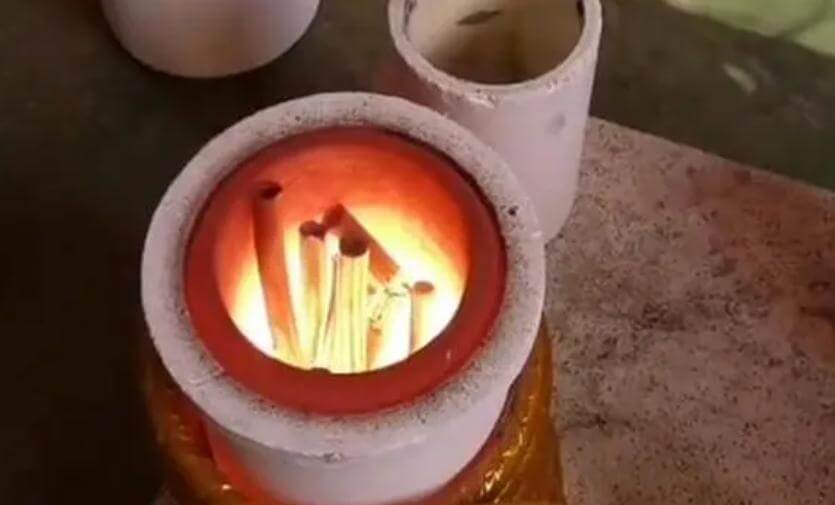
Comparison between induction melting furnace and traditional flame heating melting furnace
Compared with the traditional flame smelting process, induction heating smelting has obvious advantages such as energy saving, environmental protection, and safety.
Induction heating melting is more efficient than flame heating melting and has higher output per unit time. The heating efficiency of induction melting furnace is 30% to 50% higher than that of flame heating.
Induction melting furnace has high heating efficiency. It can also effectively reduce the burning loss of metal surface oxide scale, saving materials and costs, which is especially important for heating precious metals.
For example, under normal circumstances, when an induction melting furnace is used to heat metal parts for hot forming, the metal burn loss rate heated by induction is about 0.5%, while the burn loss rate of metal heated by a flame furnace is about 1% to 3%, which means Induction melting furnace saves 2% energy than flame heating.
In addition, the differences between the two heating methods are also reflected in the following aspects:
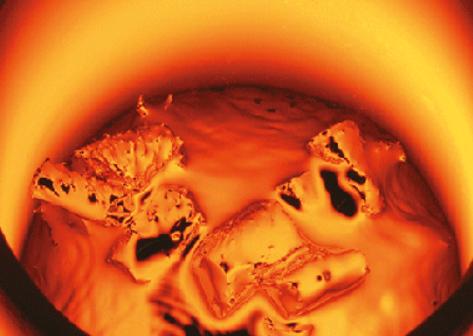
Induction melting furnaces are very easy to install and operate.
The intermediate frequency furnace is ultra-small, light-weight, movable and covers an area of less than 1 square meter.
The intermediate frequency furnace has 24-hour uninterrupted melting capability.
Induction melting furnaces can save electricity and energy.
The intermediate frequency furnace facilitates the replacement of furnace bodies of different weights, different materials, and different starting methods to adapt to various smelting requirements.
The medium-frequency induction heating furnace uses an ultra-small medium-frequency induction heating power supply, which is completely different from the traditional medium-frequency power supply.
The medium-frequency furnace has good heating permeability and uniform temperature.
The medium-frequency magnetic field produces magnetic stirring on the molten metal, which is beneficial to the homogenization of ingredients and dross.
Based on the recommended equipment and maximum smelting volume, the melting time of each furnace is 20-30 minutes.
Basic components of medium frequency induction melting furnace
The medium-frequency induction melting furnace comprises several essential components, each playing a crucial role in the efficient and controlled melting of metals.
Induction Coil: This coil is a primary component responsible for generating the electromagnetic field required for induction heating. Typically made of copper tubing, the coil surrounds the crucible containing the metal charge.
When alternating current passes through the coil, it creates a rapidly alternating magnetic field, inducing eddy currents within the metal charge, thus generating heat.
Crucible: The crucible is the vessel where the metal charge is placed for melting. It’s usually made of refractory materials capable of withstanding high temperatures and chemical reactions.
The crucible’s design ensures efficient heat transfer from the electromagnetic field generated by the coil to the metal charge.
Power Supply: The power supply is the source of electrical energy that drives the induction heating process. It converts standard alternating current (AC) power from the electrical grid into high-frequency alternating current, typically in the range of several kilohertz to megahertz.
This high-frequency power is then delivered to the induction coil to create the electromagnetic field necessary for induction heating.
The applications of medium frequency induction melting furnace
Medium frequency induction melting furnace is a powerful and efficient tool used for melting and heating purposes in various industries.
Due to its wide range of applications, the furnace has become an important part of the manufacturing process of many products. Shown below are the various applications of medium-frequency induction melting furnaces.
Metal casting
Foundries extensively employ this furnace for melting a range of metals including iron, steel, aluminum, copper, and more. Utilizing a high-frequency electromagnetic field, the furnace rapidly and uniformly heats the metal, enabling meticulous management of the melting procedure.
Subsequently, the liquefied metal is poured into molds, facilitating the production of diverse castings such as automotive parts, mechanical components, and decorative items with exceptional precision.
Jewelry making
Offering jewelers a dependable and effective means of melting precious metals like gold, silver, and platinum, this furnace stands as a cornerstone in jewelry crafting. Its rapid heating capability allows for swift attainment of high temperatures, ensuring uniform melting and preserving the purity and integrity of the metal.
With the molten metal readily available, jewelry artisans can unleash their creativity to craft intricate designs and bring forth unique pieces that captivate admirers.
Heat treatment
Apart from their primary function of metal melting, medium frequency induction melting furnaces find extensive application in heat treatment processes. They serve as invaluable tools for annealing, tempering, and hardening a wide array of materials, encompassing steel and diverse alloys.
Leveraging precise temperature regulation and uniform heating, these furnaces excel in heat treatment applications, guaranteeing dependable and uniform outcomes with unwavering consistency.
Waste recycling
Medium-frequency induction melting furnaces efficiently liquefy and refine scrap metals, facilitating their integration into the creation of fresh materials.
Through the process of melting and purifying scrap metal, these furnaces play a pivotal role in waste reduction and the conservation of natural resources.
Consequently, they emerge as environmentally conscious choices for metal recycling, contributing significantly to sustainable practices and the preservation of our planet’s resources.
Conclusion
Medium-frequency induction melting furnaces are proof of technological innovation in the field of metal melting and casting processes.
With its unparalleled efficiency, precision and versatility, the furnace revolutionizes industrial applications, enabling foundries, metalworking shops and manufacturing facilities to achieve new levels of productivity and quality.
KEXIN’s induction melting furnace has higher thermal efficiency and lower energy consumption. They can produce a mild metal bath mixture, mixing a uniform alloy at a constant and uniform temperature. For these reasons, this type of furnace is the first choice for induction melting. Kexin products can flexibly meet all customer requirements.
Can we help you?